A Collaborative Document from DMUSD Special Education Staff
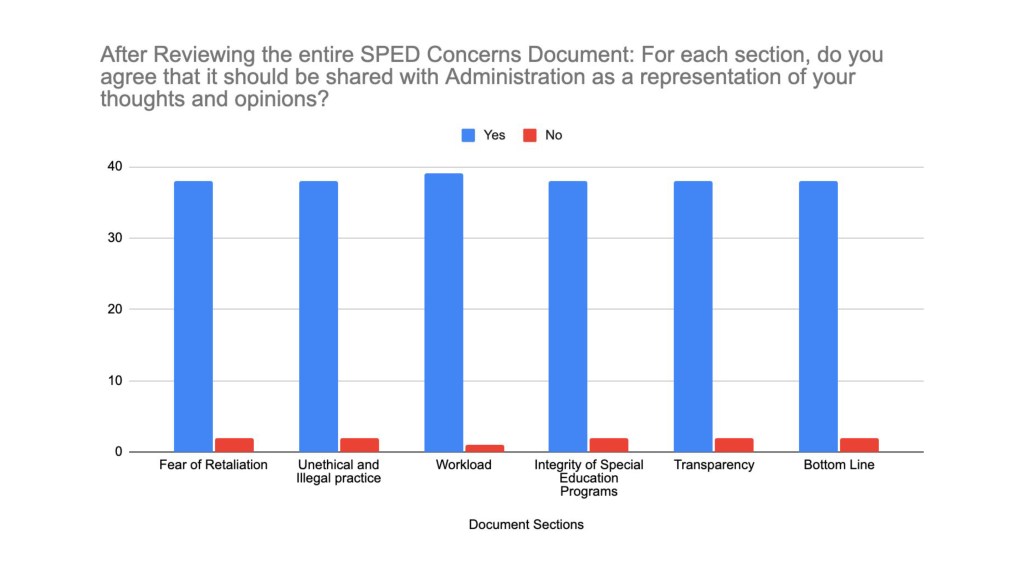
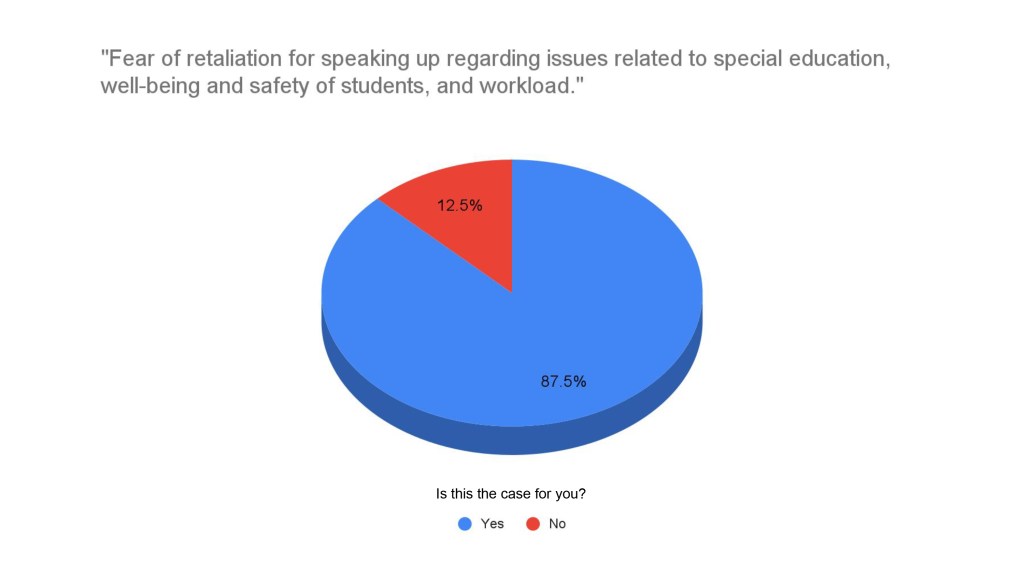
- Fear of retaliation for speaking up regarding issues relates to special education, well-being and safety of students, and workload.
- Unethical and Illegal practice.
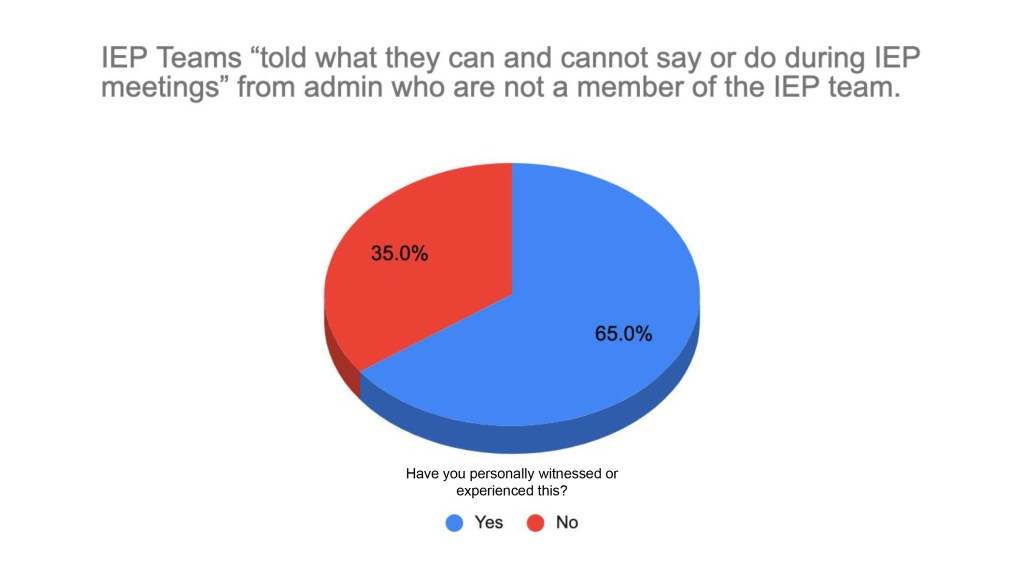
- As a special education staff, we are told we are the experts and that decisions are IEP (Individualized Education Plan) team decisions, however this is not the case. IEP teams are frequently being told what they can and cannot say/do during IEP meetings by administration through staffings, even though administrative designees are not part of the IEP team.
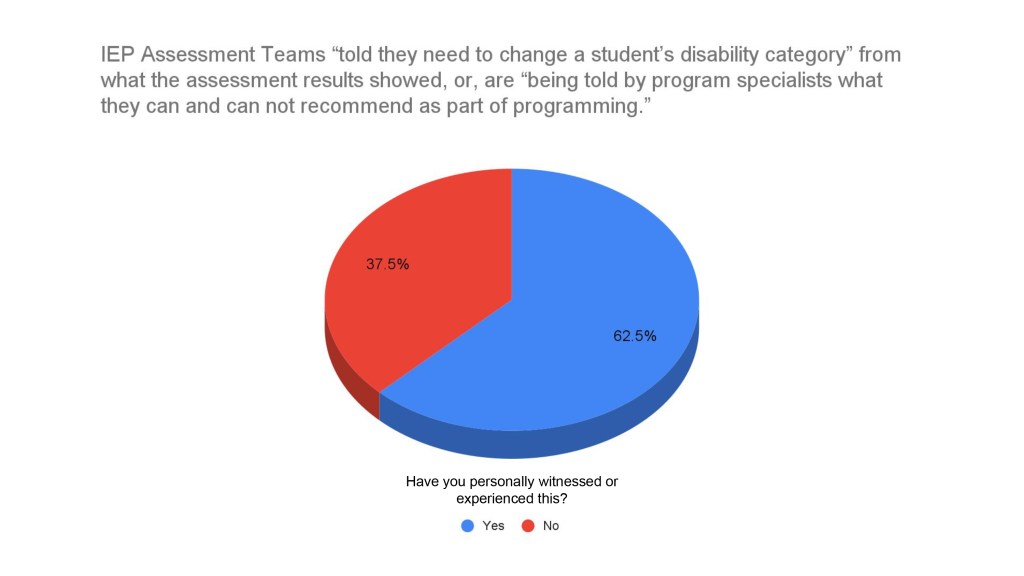
- IEP assessment teams are being sat down by Jenni and Nadine and told they need to change a student’s disability category from Other Health Impairment (OHI) to Intellectually Disabled (ID) although the assessment team found that the student was and is not intellectually disabled.
- Special education teachers are teaching in programs without holding the correct credentials.
- Classifications of programs are being changed on a whim. IEP teams are having to reclassify students to meet the new “criteria” for programs instead of the programs providing the services the student needs (i.e. an alternative curriculum or modified curriculum) as identified by the IEP team.
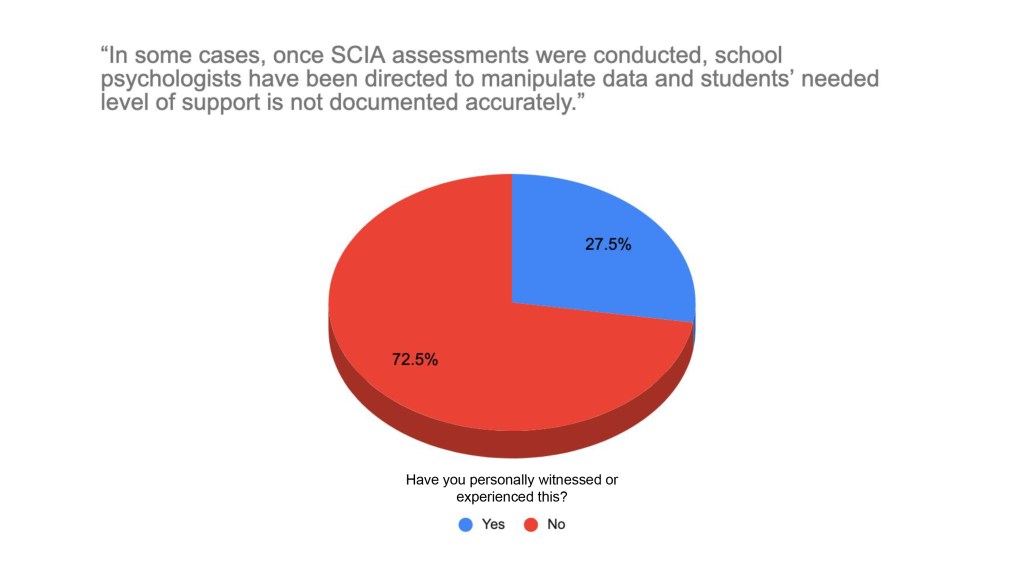
- In some cases, once SCIA assessments were conducted, school psychologists have been directed to manipulate data and students’ needed level of support is not documented accurately. This affects the safety and well-being of students and is not an accurate assessment related to the student’s level of need. Essentially the district is refusing to hire aide support and staff programs according to student need, per SCIA assessment.
- Students are not receiving their APE (Adapted Physical Education) minutes as outlined in their IEPs. Case managers of students who receive APE services are being asked to report on progress for APE goals. These case managers are not credentialed to teach that area of service and are not identified as the person responsible for the APE goals in the students’ IEPs. In addition, when make-ups are finally provided, if they are, it will be taking away from students Specialized Academic Instruction (SAI) minutes which are written as weekly minutes, not yearly minutes. APE services are written as yearly minutes. SAI minutes cannot be made up in special day classes.
- Speech and language pathologists (SLP) are being told they cannot send home evaluation plans for additional suspected disability categories that could require other services (such as specialized academic instruction). According to the state, DMUSD has a disproportionate number of Hispanic ELLs that are identified as having a SLD and require special education services. When an SLP suspects a student with a speech and language disability requires academic support, not due solely to a language deficit, they are obligated to bring this to the attention of an assessment team. This is true for other service providers as well that have observed students and believe they require their related services. However, they are told they are not able to assess.
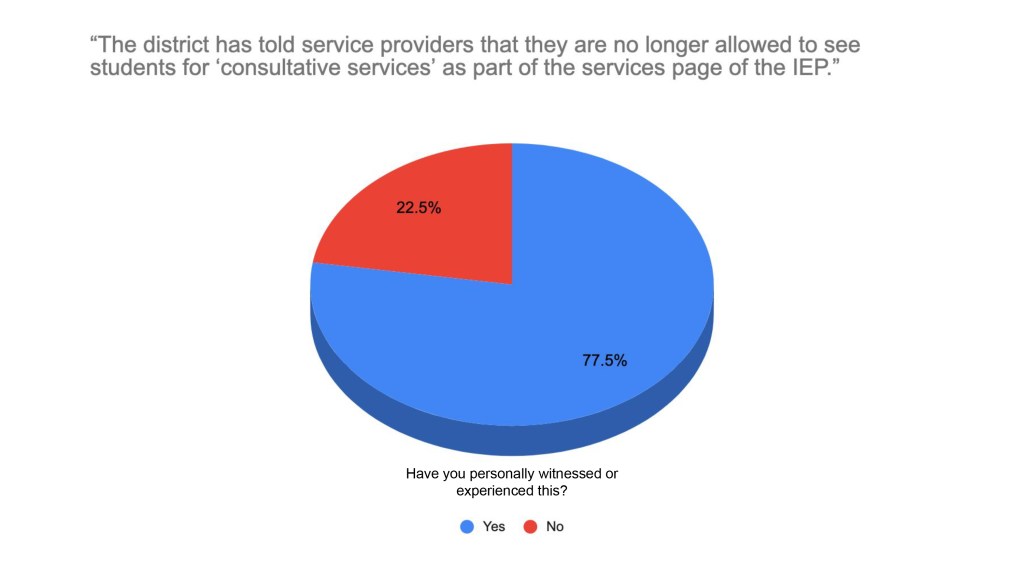
- The district has told service providers that they are no longer allowed to see students for “consultative services” as part of the services page of the IEP (therefore these students won’t count for a service provider’s caseload, yet service providers will still need to provide the services).
- Currently there is no external audit of our special education department and practices to ensure the district is acting in the best interest of students. Instead, litigation/due process is affecting the way administration is directing staff to provide and recommend services. Litigation has increased since this new administration has been in place.
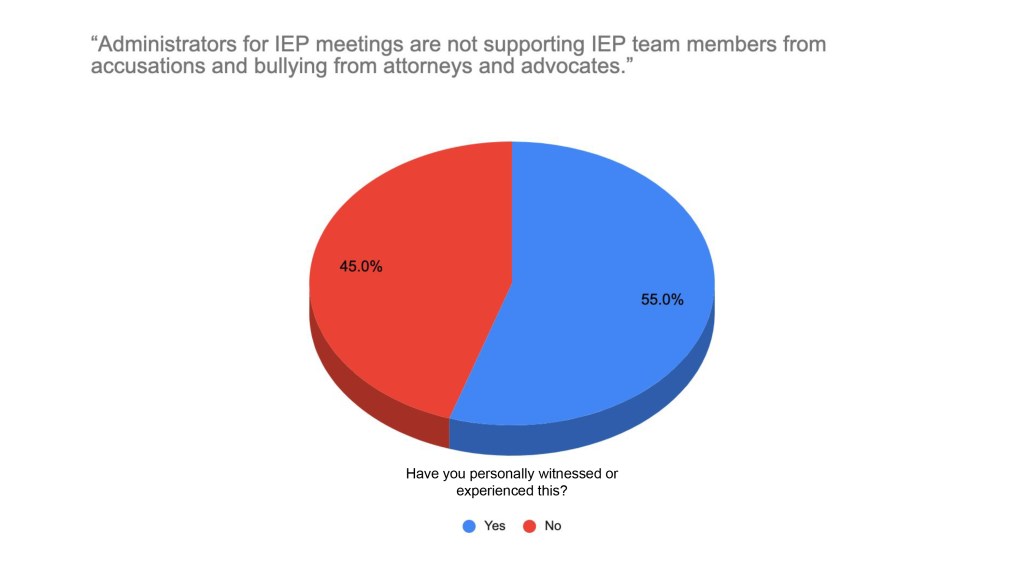
- Administrators for IEP meetings are not supporting IEP team members from accusations and bullying from attorneys and advocates. Instead of speaking up and ending the abusive talk and hostile meeting, or by setting team norms, IEP team members are attacked and scrutinized.
- IEP teams are being told by program specialists what they can and can not recommend as part of programming (i.e a less or more restrictive environment based on the student’s need).
- Workload
- Special Education staff are overworked, overwhelmed, and there are not enough minutes in the day to complete everything that is required of us. As a result, work is expected to be taken home and we are told it is an assumption of the job that we will need to do work at home, as we are salary employees and not hourly employees.
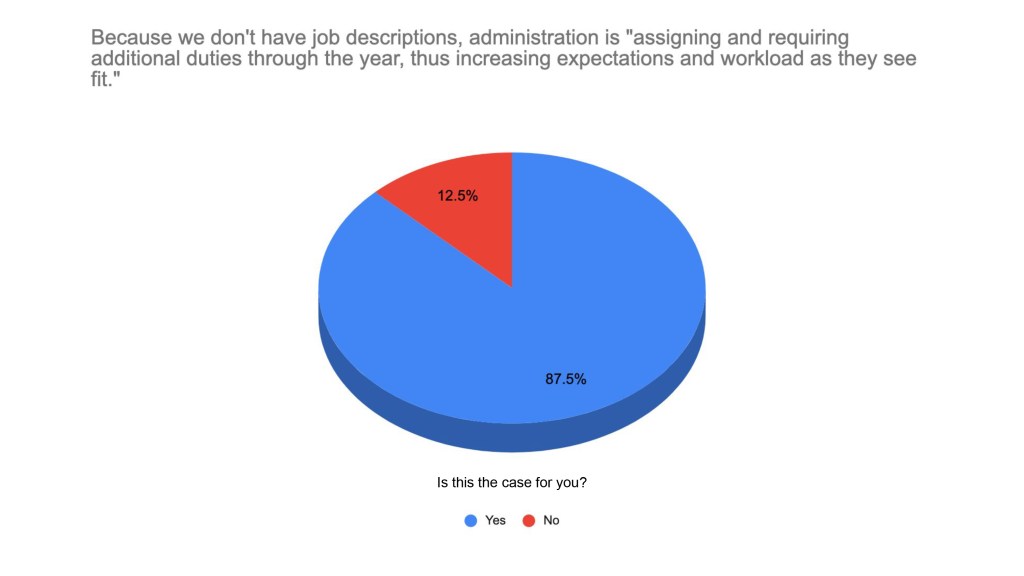
- We have no job descriptions which allows administration to keep assigning and requiring additional duties throughout the year, thus increasing expectations and workload as they see fit.
- Case managers are assigned new forms and checklists that need to be completed. We are becoming paperwork administrators instead of being able to do the most important aspect of our jobs – teach.
- Special Education staff holding similar positions have limited opportunities to collaborate with each other unlike general education teachers who are afforded the opportunity to meet as grade level teams and have common prep time. Our planning time is often pieced together across short periods of time throughout the week. In our contract it states that special education job related meetings are on an as needed basis. The need is determined by administration, not by staff.
- No time allotted for special education teachers and service providers to collaborate on specific programs and student needs within a school site except for a weekly special ed meeting where IEPs and upcoming meetings are mostly discussed.
- When staff meet with administration to discuss their current workload and the impossibility to get everything done according to legal timelines, they are told they are not managing their time properly (in some cases threatened with an improvement plan, but then later changed to a summary of conference). Administration’s response to this is to sit down with the staff members and dictate what they should be doing (i.e what assessments they should be administering, what to include in their reports, and how to reschedule their day without the knowledge of what the position entails, etc.).
As a side note: each special education service provider, (SLPs, OTs, PTs, APE teachers, and SAI teachers) have gone to school to get the correct certifications to make them experts in their fields. By being told an administrator, who has not been certified or credentialed in that area, will sit down and dictate what assessments we should administer or what services to provide, is extremely out of line. The issue is not what assessments we are giving, it is that there is not enough time to complete our workload because of all of our responsibilities. - Our legal timelines are constantly being cut short due to directives given by administration (i.e wanting a SCIA to be done in 3 weeks versus the 60 day timeline we have for assessments or shortening our 60 day timeline for multiple-disciplinary assessments so that administration can review).
- Case managers service multiple grades, some spanning over 4 grade levels, others spanning over 8. We have 120 minutes per week of planning time – this should be used for planning curriculum, lesson plans, etc. In addition to teaching we have IEPs to hold, assessments to conduct, reports to write, schedules to make and re-write, data collection, etc. etc. etc. Logistically there is no possible way that all preparation for teaching multiple grade levels and IEP process expectations can be done in 120 minutes per week. Lesson prepping alone for multiple grade levels and abilities takes more than 120 minutes per week without including IEP related tasks.
- Administration constantly references that service providers have low caseloads (not at maximum capacity as stated in the contract) and do not take into account the workload. Students are seen as numbers. There is no consideration to the amount of IEPs some students require (can be 1-10 per year given the case), amount of services provided, etc.
- If the district continues to cut service provider positions, providers will be forced to miss student’s services due to attending IEPs and will not be able to make up for these missed services due to higher caseload and an impacted schedule already (most service providers are itinerant). In addition, higher caseload will lead to inappropriate student groupings (forcing staff to group students in larger groups, which will decrease the quality of services).
- Proposal of eliminating BSI positions is not student centered or in the best interest of the district. BSIs are needed and play a vital role in both special education and general education. Instead of eliminating positions, the district should increase the number of BSIs so there is one at each school.
- The district manipulates the budget to fit an agenda (i.e. BSIs present at our school sites are more important and beneficial for the district as a whole instead of $4,000.00 tables and furniture). Direct services and personnel who provide these services should come first. We need teachers and service providers, not furniture.
- Integrity of Special Education Programs
- There is frequent movement of staff and IAs during the school year, which impacts school teams and services for students (i.e. recently SLPs were reassigned to different sites with less than ample notice resulting in two involuntary transfers).
- Special education teachers have no time to meet with the Instructional Assistants (IAs/aides) assigned to their programs to discuss instruction, student goals, or to train on implementation of curriculum and instruction. IA’s are assigned training during PTC weeks and these training sessions are often redundant and not relevant (according to feedback from IA’s). Currently we have been allotted one afternoon (1 hour and 30 minutes), twice a year, during PTC week to work with our IA’s to provide training related to the specific students and program needs.
- Some/most IAs are not well trained for the positions they are in. Case managers have no say as to what staff help support their program. We are not asked to sit in on interview panels.
- Administration is not replacing staff who have resigned/left the district (i.e.1 school psychologist, 3 SLPs, and 2 ed specialist, as examples). In addition, administration is cutting positions.
- Exceptions to “policies” are always being made. We are told we need to do things a certain way, but then in another instance an exception is made. Exceptions are made for one student, but not another. It should not be up to administration to pick and choose for students.
- Administration is not staffing appropriately in people’s absence/leaves. The amount of work placed on those left behind hugely impacts workload (i.e. putting GE subs in sped positions and then expecting existing staff to complete the case management responsibilities).
- Transparency
- Just tell us what is going on. The secrecy and lack of information makes things
much worse. Trustworthiness and integrity has a higher value in the success of any organization. If staff do not trust leadership to be forthcoming, truthful, and ethical, an organization can not function properly and staff morale is greatly impacted. - Administration is consistently and constantly contradicting themselves in information they share with staff. Sometimes even in the same meeting. Different messages are being delivered to different groups of people.
- Just tell us what is going on. The secrecy and lack of information makes things
- Bottom Line
- Special education staff are at a breaking point. We want to provide the highest quality of education and services to all of our students and also ensure that all students in the district get the correct services they need. We work for an amazing district which provides top notch education to students. However, with the issues that are happening in special education currently, this is not possible. Administration keeps piling work on top of everything we already do by cutting staff and not replacing staff who have left the district. They look at students as numbers instead of people with different and unique needs. Some students require more services and time from service providers, and that is not considered.
- The illegal and unethical directives need to stop and the people giving them need to be held accountable. The integrity of DMUSDs special education programs has been compromised.
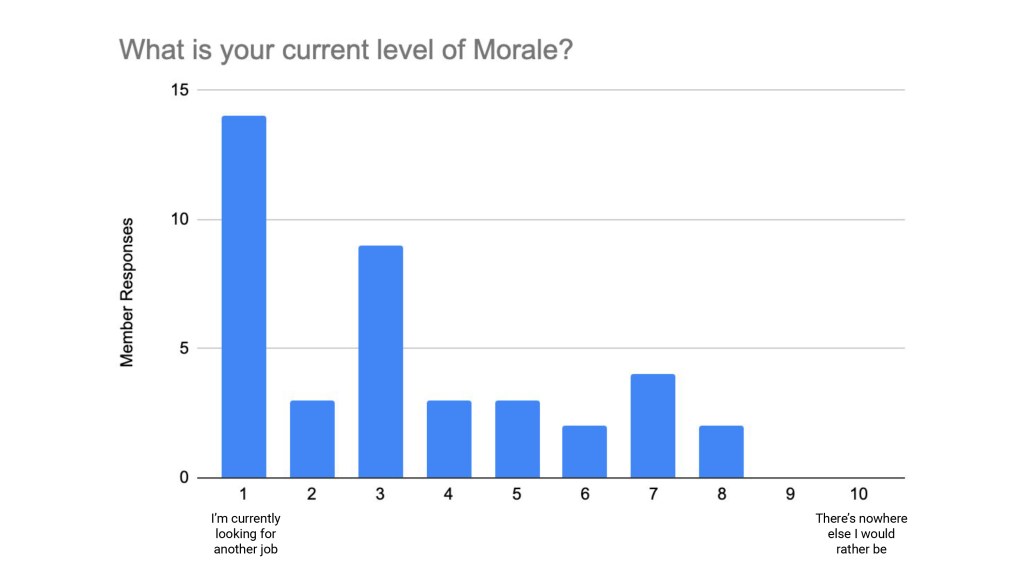
- Our morale as a staff cannot get much lower and something needs to change.
- Actions to Take
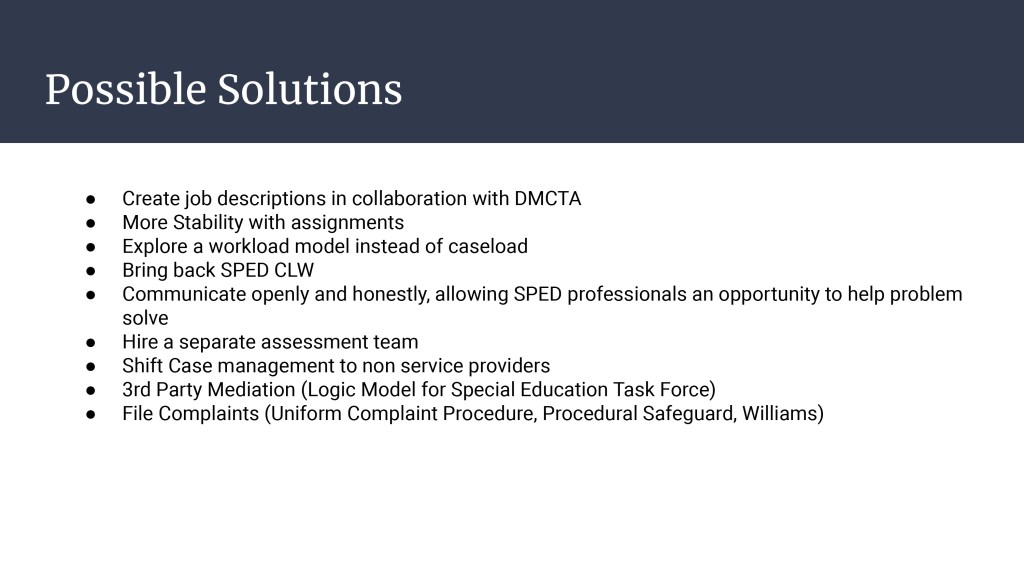
● Creation of job description for all areas of special education outlining duties and responsibilities.
● Actions taken to address workload versus caseload (maximum number of students to be served by a specialist).
● An anonymous survey to assess the current climate and health and wellbeing of personnel in special education positions (Special education staff have resigned in the greatest numbers of any two years and/or are under the care of physicians for job related stress. Mental health of special educators and morale is at an all time low).
● Keep the BSI positions intact – they are vital to special education, general education, and our district.
 DMUSD Accountablility